Volume Correction: Increase, Decrease or Normalize Audio & Video Volume

Complete guide to adjusting decibel gain, volume normalization, and quiet video audio fixes

Quick Overview & Key Features

  • Supported Formats: MP4, MKV, AVI, MOV, MP3, AAC, FLAC, AC3, WAV, and more.
  • Correction Modes: Percentage Change (%), Decibel Gain (dB), Audio Normalization (dB).
  • Zero Video Quality Loss: Use Video "Copy" mode to adjust audio volume in seconds without re-encoding video.
  • License: 100% Free Video & Audio Converter for Windows.

XMedia Recode is a powerful, free video editing tool and converter that allows users to easily adjust video volume. Whether you have a video file whose volume is too quiet or you want to reduce loud audio without distortion, XMedia Recode provides professional-grade volume correction tools.

With support for almost all common video and audio formats (MP4, MKV, AVI, MP3, AAC, etc.), you can perform precise decibel changes or automatic peak normalization while maintaining optimal sound quality.

How to Change Video or Audio Volume

Using the volume correction filter, you can permanently modify the sound level of your media files or balance sound across multiple videos.

Pro Tip (Fast Processing without Re-encoding Video):
If you only want to adjust the audio volume of a video, set the Mode to "Copy" under the Video tab. This keeps the video stream bit-for-bit unchanged without losing video quality and finishes the conversion in just a few seconds!

Step-by-Step Guide: How to Adjust Video Volume

In this tutorial, we will show you step-by-step how to permanently fix quiet video sound, boost audio gain, or normalize volume across your files.

Step 1: Select the "Filter/Preview" tab and click the "Audio Track" tab

After opening your video file, navigate to the Filter/Preview tab and select the Audio Track sub-tab. Click the "Add filter" button.

Selecting Filter Preview tab and Audio Track in XMedia Recode for video volume correction

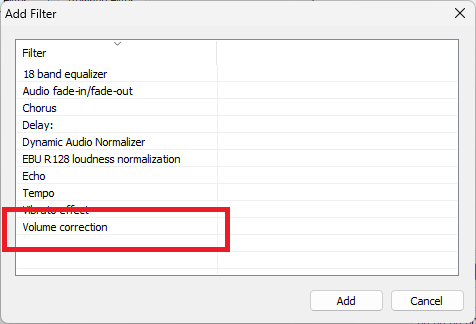
Step 2: Select "Volume correction" filter and click "Add"

From the dropdown menu of audio filters, choose Volume correction and click the Add button to apply it to your current audio track.

Adding the Volume Correction audio filter from the audio filter list in XMedia Recode

Step 3: Choose Volume Correction Method and Adjust Settings

Configure how you want to alter the audio signal: Percentage adjustment, Decibel gain, or Peak Normalization.

Volume Correction filter settings window in XMedia Recode showing percent, dB gain, and normalization options

Step 4: Activate the Volume Correction Filter

Ensure the filter is active. Clicking the eye icon toggles the Volume correction filter between enabled and disabled status.

Volume correction filter activated (eye visible)

Volume Correction filter activated with eye icon enabled in XMedia Recode

Volume correction filter disabled

Volume Correction filter disabled with eye icon turned off in XMedia Recode

Detailed Explanation of Volume Correction Methods

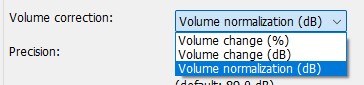
XMedia Recode provides three flexible methods to modify audio volume depending on your specific audio file requirements:

  • Volume change (%) – Quick relative percent gain/reduction
  • Volume change (dB) – Precise logarithmic decibel amplification
  • Volume normalization (dB) – Automated target loudness analysis
Dropdown menu showing volume correction methods: percent change, decibel gain, and normalization

1. Volume Change (%)

Adjusting volume in percentages is ideal for quick changes without needing decibel math.
For instance, setting the slider to 200% doubles the volume for quiet clips, while setting it to 50% cuts loud audio in half.

Adjusting audio volume in percentage from 50% to 200% in XMedia Recode

2. Volume Change in Decibels (dB)

Decibel adjustment provides exact logarithmic control over your sound signal.
Adding +3 dB noticeably boosts quiet audio, while +6 dB effectively doubles the signal level. Use this setting when you know precisely how much louder or quieter the audio needs to be.

Boosting audio gain in decibels (dB) for quiet video files in XMedia Recode

3. Volume Normalization (dB)

Audio Normalization automatically analyzes the peak and average audio levels of your file and calculates the necessary gain boost or attenuation to match a target volume level in decibels (dB).

This is extremely useful when converting multiple video files from different sources to ensure consistent audio levels across your entire media library.

  • Normalize (dB): Defines the target average or peak volume level in decibels.
  • Track Volume: Displays the measured audio level of the original file.
  • Track gain: Displays the calculated decibel difference required for normalization.
Audio volume normalization settings showing Track Volume, Track Gain, and target Normalize dB in XMedia Recode

Using the "Analyze" Button:

Clicking "Analyze" scans the entire audio track and determines its exact current peak/average volume, allowing XMedia Recode to calculate precise gain without causing sound distortion or clipping.

Analyzing audio stream peak volume and target decibels in XMedia Recode

Frequently Asked Questions (FAQ)

How do I make a video louder if the audio is too quiet?
Import your video into XMedia Recode, open the Filter/Preview tab, click Audio Track, and add the Volume Correction filter. Select either Volume change (dB) (e.g., +3 dB to +6 dB boost) or Volume normalization (dB) to increase the sound level automatically.
What is the difference between Volume Change (dB) and Volume Normalization (dB)?
Volume Change (dB) applies a fixed decibel adjustment to the entire audio stream regardless of its original volume. Volume Normalization (dB) scans the track first and automatically calculates the exact gain needed to bring the peak or average volume to a designated target level.
Can I change video volume without losing video quality?
Yes! Under the Video tab, set the Mode to "Copy". This passes the video stream through untouched without re-encoding (zero quality loss and super fast conversion), while only the audio track is processed with the volume adjustment.

Share